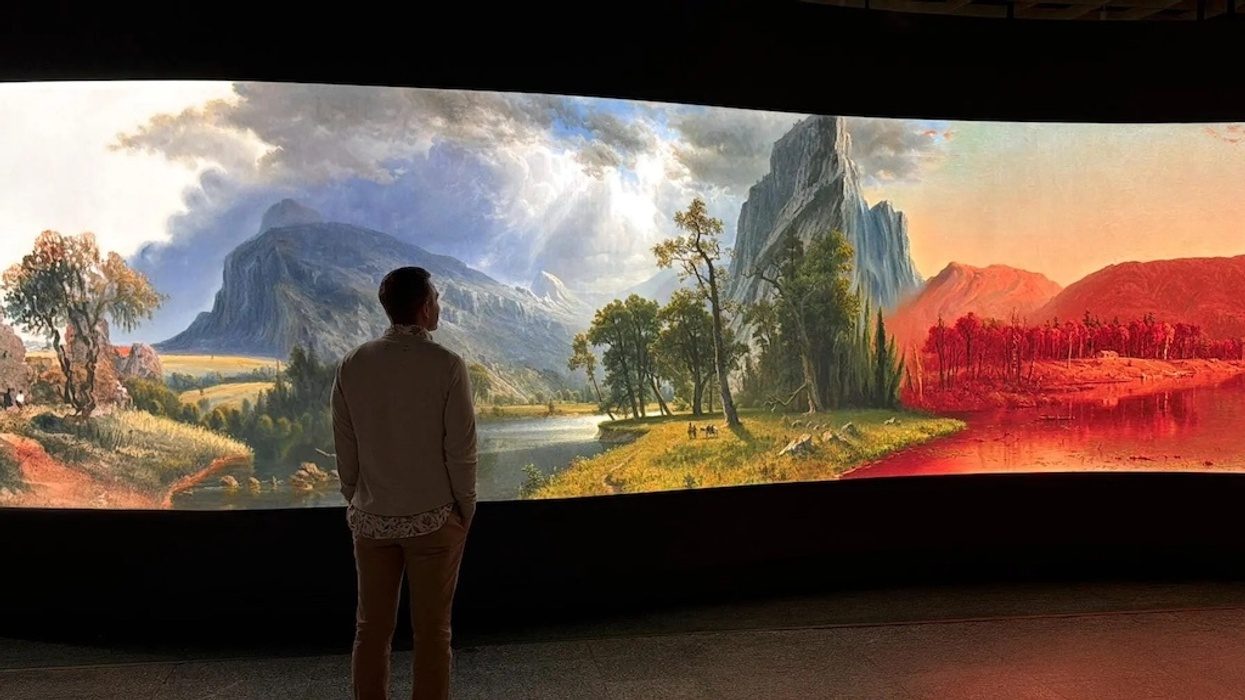
The news isn't a museum adding AI. It's that the model runs locally, trained only on the museum's own collection, a governance choice rather than a feature.
The Cleveland Museum of Art opened ArtLens Reimagined on July 28, 2026, a 10,000-square-foot space housing 21 new interactive experiences, according to Blooloop. It runs on locally-run AI models trained exclusively on the museum's own collection; one installation, Infinite Landscape, generates scenery on a 24-foot curved wall. The gallery is organized into five themed zones, Relate, Investigate, Create, Explore and Infinite Landscape, with Chief Digital Innovation officer Jane Alexander describing the technology as the bridge that helps people engage more deeply.
The signal is 'local' and 'own collection'
The easy headline is that a museum added AI. The real signal is in two choices the museum made deliberately: locally-run, and trained only on its own collection. Most public-facing AI today calls a third-party cloud model trained on the open internet. Cleveland did the opposite, running the model on-premise and training it only on assets it owns and controls. That is a governance decision dressed as an exhibit. It means no visitor prompt leaves the building, no output is contaminated by scraped material of unknown provenance, and every generated frame traces back to work the institution has the rights to.
That choice moves the cost and the control at once. Owning the model and its training set is more work up front than renting an API, but it converts an ongoing per-call dependency into an asset the institution holds. For any brand or venue nervous about where its data goes and what its AI might say, that trade, more setup in exchange for more ownership, is quickly becoming the defensible default rather than the cautious exception.

What a producer can do now
When a client asks for AI in the experience, make the provenance conversation the first one, not the last. Ask whether the model can run locally, what corpus it is trained on, and who owns the outputs, because those answers decide the legal and reputational risk long before they decide the visuals. A collection-trained model also gives you something creatively sharper: an installation that can only speak in the client's own material, which reads as authored rather than generic. Persistent, responsive rooms like large-scale interactive art environments get more credible, not less, when the intelligence behind them is bounded to a known body of work.
This belongs in an experiential toolkit because 'trained only on what we own, running where we control it' is a pattern every brand activation will eventually need. A retail flagship, a heritage archive, a product launch, each has a proprietary corpus and a reason to keep visitor interaction private. The museum is simply an early, well-governed example of a model that the rest of experiential work is heading toward.
SensaLab is the white-label real-time 3D and immersive layer that agencies and brands use to design and build interactive spaces under their own name, so the model, the collection, and the visitor relationship remain yours.