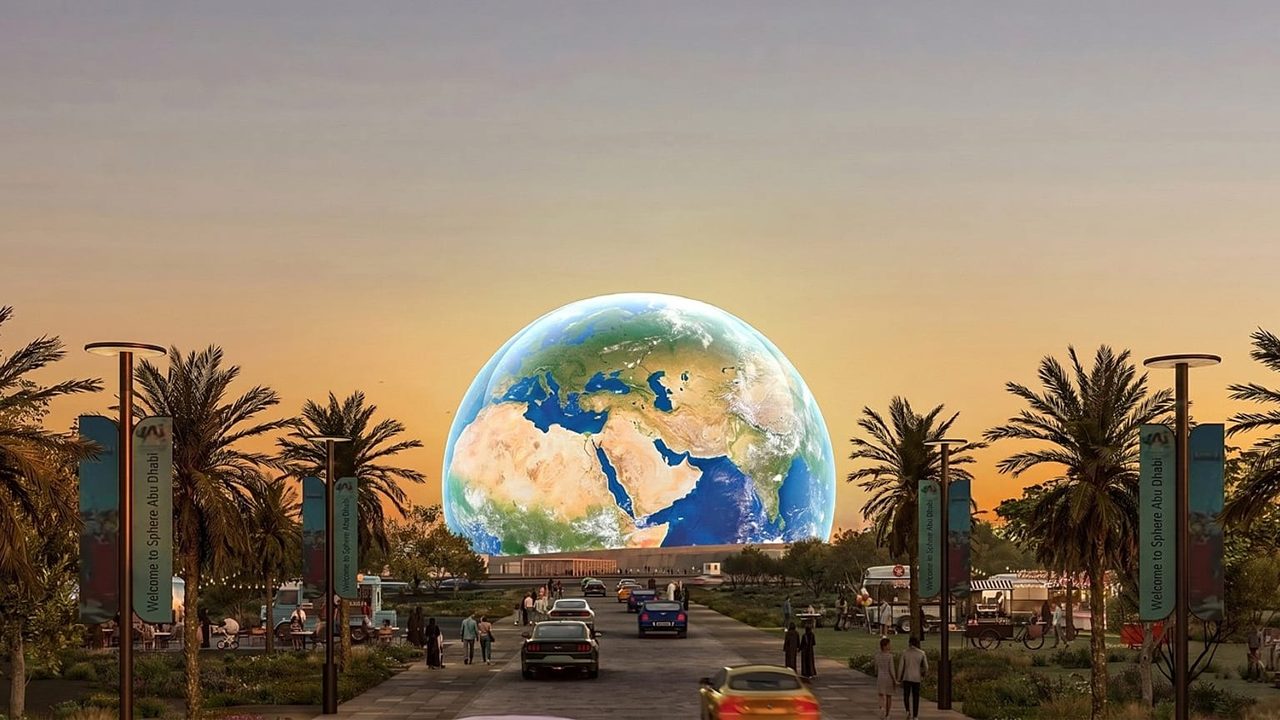
The news is not a second Sphere. It is that a single-city spectacle is becoming a licensable global format and a skyline-scale brand canvas.
Sphere Entertainment has unveiled Sphere Abu Dhabi, a venue on Yas Island that will be its first outside the United States. According to the announcement, the project is backed by a USD $1.7 billion investment from the Department of Culture and Tourism - Abu Dhabi and is designed to hold up to 20,000 spectators. Its exterior Exosphere will act as a giant LED canvas visible across the skyline, programmed to showcase Emirati artists, culture and heritage. Sited on Yas Island between Yas Mall and SeaWorld Abu Dhabi, it is expected to open by the end of 2029, following the Las Vegas Sphere that opened in 2023.
The real signal is not a second Sphere. It is that a venue born as a single Las Vegas landmark is now being handled as an export format, licensed, capitalized by a tourism authority, and repositioned as civic infrastructure. The shifted cost is who pays: a $1.7 billion build underwritten as a national destination and a skyline-scale canvas, not a promoter's gamble on ticket revenue alone. That changes the economics behind every brief that touches the building.
A city-scale canvas enters the brief
For a producer, the Exosphere is the line worth underlining. A programmable exterior visible across a skyline is a media placement measured in city blocks rather than billboards, and its stated first job is cultural, showcasing Emirati artists and heritage rather than logos. That reframes what an immersive venue can carry: not only the show inside, but a public-facing surface a brand or cultural partner might occupy for a night. Planning against that means treating the outside of the building as inventory, with its own creative rules and its own approvals. That is a surface most experiential toolkits have no template for yet.

Why the export matters to your toolkit
Two Spheres on two continents turn a novelty into a category. Once the Sphere's live-venue format exists in more than one market, content designed for a wraparound interior and a spherical exterior becomes reusable rather than strictly site-specific. For experiential teams, that is the argument for building assets to a venue standard now, so a piece made for one hemisphere can travel to another without a full rebuild when the Abu Dhabi doors open. A standard, once it exists, is what lets a small idea scale without losing its edges.
A long runway, not a far-off event
An end-of-2029 opening reads as distant, but the pipeline is not. Venues at this scale commission content years ahead, and a culture-first mandate signals demand for work that speaks to place and heritage rather than generic spectacle. Producers who understand spherical grammar and regional storytelling today are positioning for briefs that will land well before the venue's doors do. The safest assumption is that the good slots fill early.
That is the layer we build. SensaLab is the white-label real-time 3D and immersive layer that agencies and brands use to design and run experiences under their own name, including content built to a spherical venue standard so a single idea can travel cleanly between markets.